

Screw On Aluminum Closures for Wine Bottles with Pressure Control
Screw On Aluminum Closures for Wine Bottles with Pressure Control: A Metallurgist’s View from Inside the Cap
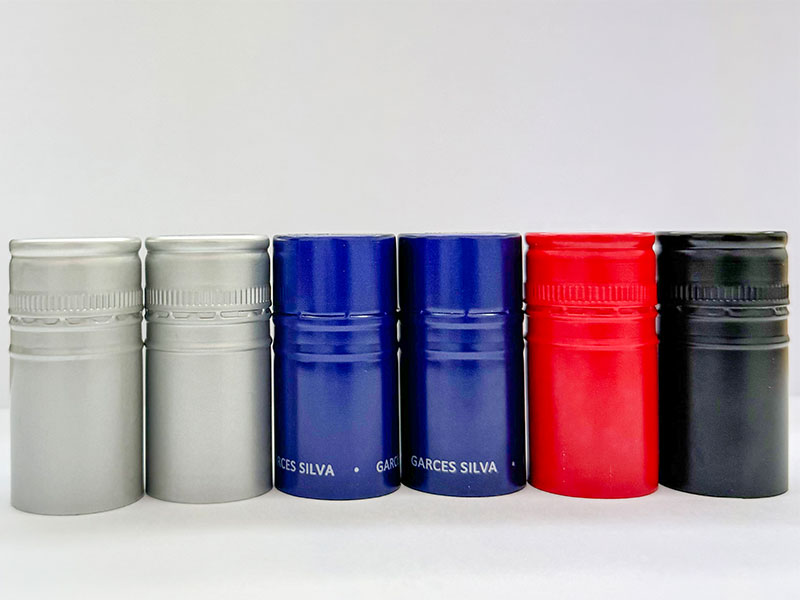
Screw-on aluminum closures for wine bottles with pressure control are usually discussed from the outside: branding, convenience, consumer perception. Yet the real story starts inside the metal itself—inside the crystal lattice, the alloying elements, the tempering history, and the tight interaction between closure design and internal bottle pressure.
Looking at these closures from a metallurgist’s perspective reveals why some caps survive years of cellaring, carbonation peaks, and temperature swings without distortion or leakage, while others slowly creep, deform, or compromise the seal. The closure is not just a “lid”; it is a tuned pressure-management component built around a carefully engineered aluminum alloy system.
Below is a deep dive into screw-on aluminum closures for wine bottles with pressure control, told from the vantage point of alloy design, temper selection, and functional parameters.
Why Aluminum, and Why This Aluminum?
The choice of aluminum for wine closures is not arbitrary. Steel is strong but heavy and prone to corrosion in acidic environments. Plastics are easy to mold but suffer from creep, oxygen permeability, and recyclability issues. Aluminum occupies an unusual sweet spot:
- High specific strength, even in thin wall sections
- Excellent formability during drawing and thread rolling
- Corrosion resistance supported by a natural oxide film
- Full recyclability with a strong scrap value stream
However, not all aluminum behaves the same under pressure. For wine applications—especially for closures managing slight to moderate internal pressures (from dissolved CO₂ or temperature-driven expansion)—the alloy must resist stress relaxation and maintain thread integrity while staying ductile enough for production.
A common family of materials is the 3xxx series (Al-Mn-based alloys) or optimized versions of 8xxx and 5xxx, customized by closure manufacturers. These alloys stabilize mechanical strength through solid-solution and dispersion hardening, while maintaining good deep-drawing behavior.
The “Pressure Control” Aspect: More Than Just a Tight Cap
Pressure control in a screw-on aluminum closure is a subtle balance. The cap must:
- Seal perfectly at low pressure
- Tolerate modest internal overpressure without permanent deformation
- Not “over-seal” to the point of damaging threads or liners
- Support controlled gas exchange if designed to mimic traditional cork aging
The closure interacts with three main components:
- The glass lip and thread geometry
- The liner or gasket system inside the closure shell
- The internal wine-gas equilibrium (CO₂, oxygen, nitrogen headspace)
From inside the metal, this means the closure must provide a predictable elastic response under hoop and axial stresses. The alloy’s yield strength, Young’s modulus, and work-hardening behavior decide whether a closure will spring back after capping—or slowly give in under sustained pressure, allowing micro-leaks or liner relaxation.
Typical Alloy and Temper Used in Screw-On Wine Closures
For screw-on aluminum closures with pressure control features, manufacturers often favor:
- Alloy family: 3105, 8011, or customized variants
- Temper: H14, H16, H18, or proprietary controlled tempers
- Processing route: hot rolling → cold rolling → annealing / partial annealing → final cold reduction
A typical configuration might be:
- Base alloy: 8011A
- Temper: H14 (moderately strain-hardened)
- Thickness: about 0.20–0.25 mm for standard still wines; slightly heavier for higher internal pressure applications or sparkling variants
The H14 temper gives a balance of:
- Sufficient yield strength to preserve thread form
- Enough ductility to tolerate folding, head forming, and knurling
- Controlled springback after application torque
Mechanical and Performance Parameters that Matter
From a design perspective, the closure is a thin-walled cylinder under combined torsion, axial compression, and internal pressure. The most relevant parameters include:
- Nominal wall thickness: typically 0.18–0.25 mm for still wine closures
- Ultimate tensile strength: commonly around 130–180 MPa, depending on alloy and temper
- Yield strength (Rp0.2): generally 60–140 MPa, tuned to closure size and pressure range
- Elongation: around 8–20% in the rolling direction to support deep drawing and cold working
- E-modulus: about 69–72 GPa, essentially constant across aluminum alloys
Application parameters on the bottling line are equally critical for pressure control:
- Application torque range: optimized so the cap plastically forms around the glass thread but does not exceed the elastic reserve; typically in the range of 15–30 N·m depending on closure design and bottle standard
- Top load (axial load during capping): carefully controlled to compress the liner without crushing the aluminum skirt
- Thread depth and pitch: matched to glass standard (such as BVS finishes) to ensure even stress distribution
These mechanical conditions allow the closure to behave like a controlled spring: elastic enough to maintain seal under cyclic loads (transport, temperature changes) but not so soft that it permanently deforms under normal internal pressure.
Implementation Standards and Interface with Glass
Pressure-controlled aluminum closures for wine generally align with industry standards for bottle finishes and quality control, such as:
- BVS finishes (e.g., 30×60 mm closures for still wine)
- CETIE recommendations for finish dimensions and glass tolerances
- ISO or EN standards related to aluminum strip, mechanical properties, and coatings
The interaction with the glass bottle is governed by strict dimensional tolerances:
- Bottle finish diameter, roundness, and thread height are controlled within tight limits
- Closure inside diameter, thread profile, and sidewall concentricity must match those glass tolerances
- The sealing surface between liner and glass lip is designed to generate a controlled compression zone
Within this system, “pressure control” does not necessarily mean a dedicated relief valve, but rather:
- A predictable mechanical response under pressure and thermal expansion
- The ability of the elastomeric or compressible liner to deform and partially redistribute stresses
- A stable engagement torque that does not decay rapidly over time due to creep in the metal or liner
Certain specialized closures for lightly sparkling or lightly carbonated wines may incorporate engineered venting points or tailored liner formulations that allow controlled gas transmission, always with the aluminum shell providing the structural envelope.
Alloy Tempering: Tuning the Internal Microstructure
The temper of an aluminum closure is a record of its thermal and mechanical history. For wine caps, the temper determines how the closure will behave when rolled, drawn, threaded, knurled, applied, and then loaded by internal bottle pressure.
tempering stages include:
- Solution and homogenization of cast ingot: dissolving and redistributing alloying elements such as Fe, Si, Mn
- Hot rolling: breaking down the cast structure and refining grains
- Cold rolling: producing the textured, work-hardened state that offers strength
- Intermediate annealing or partial annealing: softening the material for deep drawing, while retaining enough strain hardening capability
- Final cold reduction: setting the final strength and temper (H14, H16, H18, etc.)
From a microstructural viewpoint:
- H14 shows a balanced mix of recovered sub-grains and dislocation density, good for screw caps that need controlled formability
- H18 is harder and stronger, with higher dislocation density, more suited where high pressure resistance is needed and forming operations are less severe
The temper is chosen not only for mechanical strength but also for compatibility with interior coatings, printing, and embossing. Overly hard alloys can crack during deep drawing; overly soft tempers may deform under long-term internal pressure, especially at elevated storage temperatures.
Surface Engineering: Coatings, Lacquers, and Liners
The performance of a pressure-controlled screw cap is as dependent on surface chemistry as it is on bulk metal strength.
Common layers include:
- Conversion coating: a thin, chemically bonded layer that improves corrosion resistance and paint adhesion
- Interior lacquer: often an epoxy, BPA-NI epoxy, or alternative food-grade polymer to protect the aluminum from the wine’s acidity and sulfites
- Exterior lacquer and ink: for branding, color, and UV resistance
- Liner or wad: a synthetic or composite disc or insert providing the primary barrier and compressible seal
The aluminum alloy must have:
- Controlled surface roughness for good coating wetting
- Stable oxide behavior to prevent under-film corrosion
- Compatible chemistry to avoid reaction with adhesives or liner materials
Pressure control is driven by the liner’s elastic and viscoelastic properties but supported by the aluminum shell’s stiffness. If the metal is too rigid, liner compression may be so high that gas diffusion is drastically reduced and bottle pressure spikes. If it is too compliant, the top load during capping may over-compress the liner initially, and subsequent relaxation can lead to reduced seal integrity.
Chemical Composition: A Metallurgical Snapshot
A representative alloy for wine screw caps (for example, an 8011A-type alloy in H14 condition) might have a chemical composition similar to the table below. Values are approximate typical ranges; actual specifications vary among producers.
| Element | Typical Content (wt%) | Functional Role |
|---|---|---|
| Al | Balance | Base matrix, high formability, good corrosion resistance |
| Si | 0.40–0.80 | Enhances strength and improves castability; interacts with Fe to form fine dispersoids |
| Fe | 0.60–1.00 | Increases strength via intermetallics; must be controlled to avoid excessive brittleness |
| Cu | ≤ 0.10 | May slightly strengthen; typically kept low to maintain corrosion resistance in acidic wine environment |
| Mn | 0.10–0.50 | Improves strength and recrystallization behavior; refines grain structure |
| Mg | ≤ 0.10 | Minor solid-solution strengthening; limited to preserve formability and corrosion resistance |
| Zn | ≤ 0.20 | Usually kept low; avoids galvanic issues and maintains corrosion performance |
| Ti | ≤ 0.05 | Grain refiner; helps control as-cast structure and improves uniformity |
| Others (each) | ≤ 0.05 | Impurities or trace additions, strictly limited |
| Others (total) | ≤ 0.15 | Total of all minor impurities |
This chemistry is intentionally conservative. The closure must accommodate intense forming operations—cup drawing, redrawing, thread rolling—without cracking, yet retain sufficient strength to resist creep and deformation under bottle pressure.
How Pressure Control Manifests in Real Use
When a winemaker chooses a screw-on aluminum closure with pressure control, several real-world phenomena are being managed:
- Elevated pre-bottling CO₂ in fresh whites or rosés that may lead to modest internal pressures
- Temperature fluctuations during shipping and storage, which increase internal headspace pressure as temperatures rise
- Long-term aging, where some closures are designed to emulate a cork-like oxygen ingress profile while still containing occasional overpressure events
From inside the alloy, this translates into:
- A closure that does not yield irreversibly under maximum expected bottle pressures
- A liner-metal combination that maintains contact around the entire circumference, even with slight glass finish variations
- A thread zone that carries torsional and axial loads while remaining dimensionally stable over time
In practice, manufacturers often test closures through:
- Internal pressure burst tests
- Torque retention measurements over time and at different temperatures
- Thermal cycling and humidity cycling
- Corrosion tests in alcoholic and acidic environments
These tests validate that the chosen alloy and temper behave predictably right up to the limits of specified internal pressure.
Most marketing discussions about screw caps start with the outer surface—color, print, brand identity. A metallurgical approach reverses this logic and designs the closure from the inside out:
- Define the worst-case internal pressure profile based on wine style, CO₂ content, and logistic temperature window
- Select an alloy and temper that offer enough yield strength to stay elastic under that scenario, with a safety margin
- Adjust wall thickness and skirt length to fine-tune circumferential stiffness and resistance to ovalization
- Choose a liner system whose compression modulus complements the alloy stiffness and glass geometry
- Only then address coatings, decoration, and aesthetic details
By treating the aluminum shell as a precision pressure vessel rather than a decorative shell, the designer ensures that the closure is structurally honest: it resists pressure, manages stress, and protects the wine as a reliable, engineered system.